史跡 · Beyoğlu, イスタンブール
Republic Monument
Cumhuriyet Anıtı

営業時間
| 月曜日 | 00:00 – 23:59 |
|---|---|
| 火曜日 | 00:00 – 23:59 |
| 水曜日 | 00:00 – 23:59 |
| 木曜日 | 00:00 – 23:59 |
| 金曜日 | 00:00 – 23:59 |
| 土曜日 | 00:00 – 23:59 |
| 日曜日 | 00:00 – 23:59 |
2026-08-24 の OpenStreetMap の営業時間から解析されました。
アクセスと設備
- 段差なくアクセス可能 · 利用可能
OpenStreetMap アクセス タグから読み取ります。記載されていないものにはタグが記録されていません。
プランナーでグループ タイプをファミリーに設定し、1 日の枠を 1 人の 1 日の約 4 分の 3 に設定します。
- 今日
- 本日の営業時間: 00:00 – 23:59
- 訪問期間
- 10分
- アクセシビリティ
- ステップフリー
- 価格
- 入場無料
- 評価
- 必見
- ランク
- 8,133 の 101 をランク付け
Republic Monumentについて
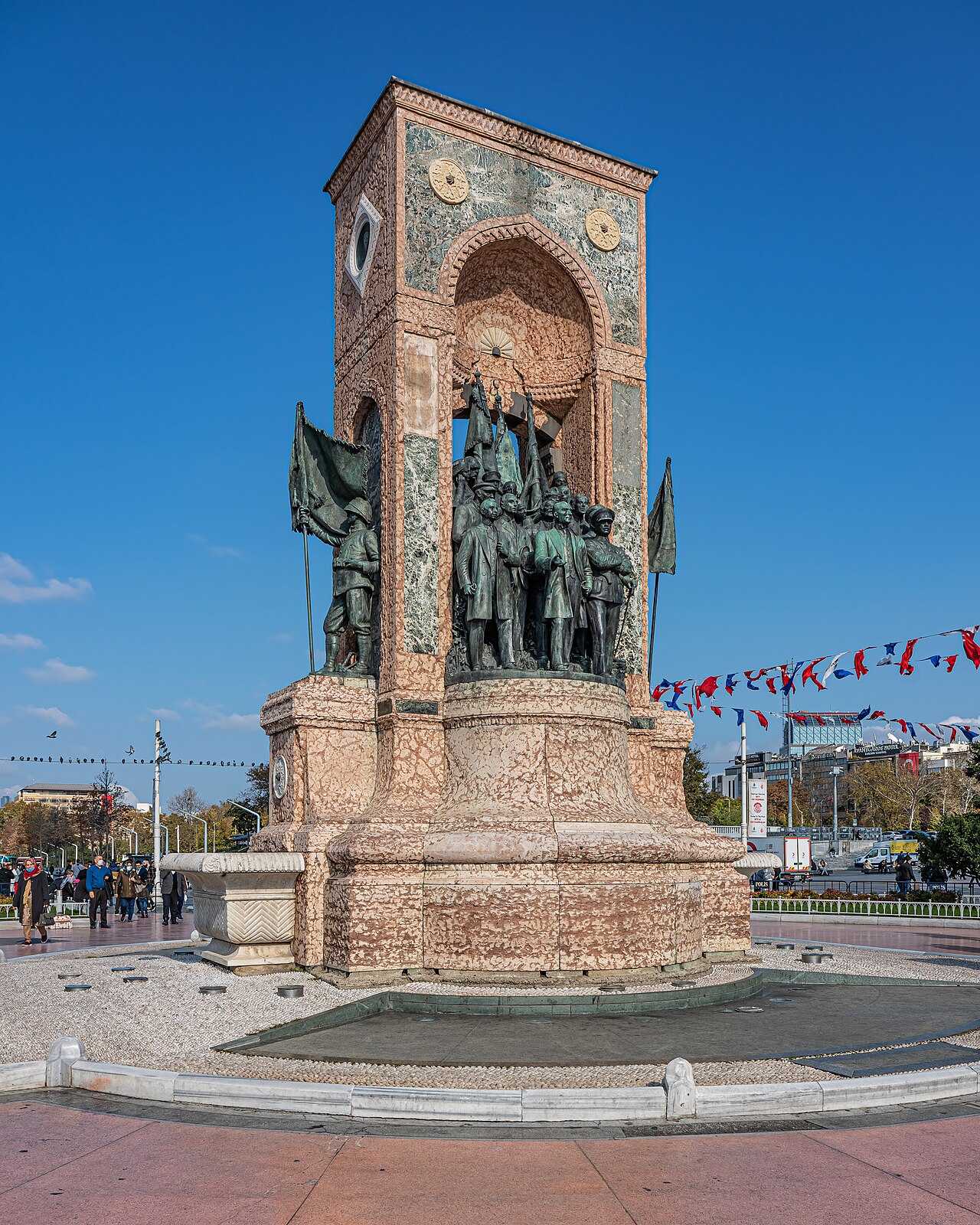
The Republic Monument stands in the middle of Taksim Square and is the founding statement of the Turkish Republic rendered in bronze and marble. It was designed by the Italian sculptor Pietro Canonica, took two and a half years to build, and was unveiled on 8 August 1928, five years after the Republic was declared. It was paid for with financial support from the population rather than out of a single state purse, which is part of why it reads as a civic object rather than a court one.
The structure rises eleven metres, with bronze figure groups set into a marble armature. There is no interior, no gate, no ticket desk and nothing to queue for; it is a sculpture in an open square that a visitor walks around.
Its setting explains its meaning. Taksim takes its name from the Arabic word for division or distribution, after the water distribution point established here under Sultan Mahmud I, and the square's modern form dates from the redevelopment that followed the demolition of the Taksim Artillery Barracks in 1940 under the plan of the French architect Henri Prost.
2026-08-24 を確認しました · ソース
中には何が入っているのか
What there is to look at is two faces that say two different things, and a visitor who sees only one has seen half the monument.
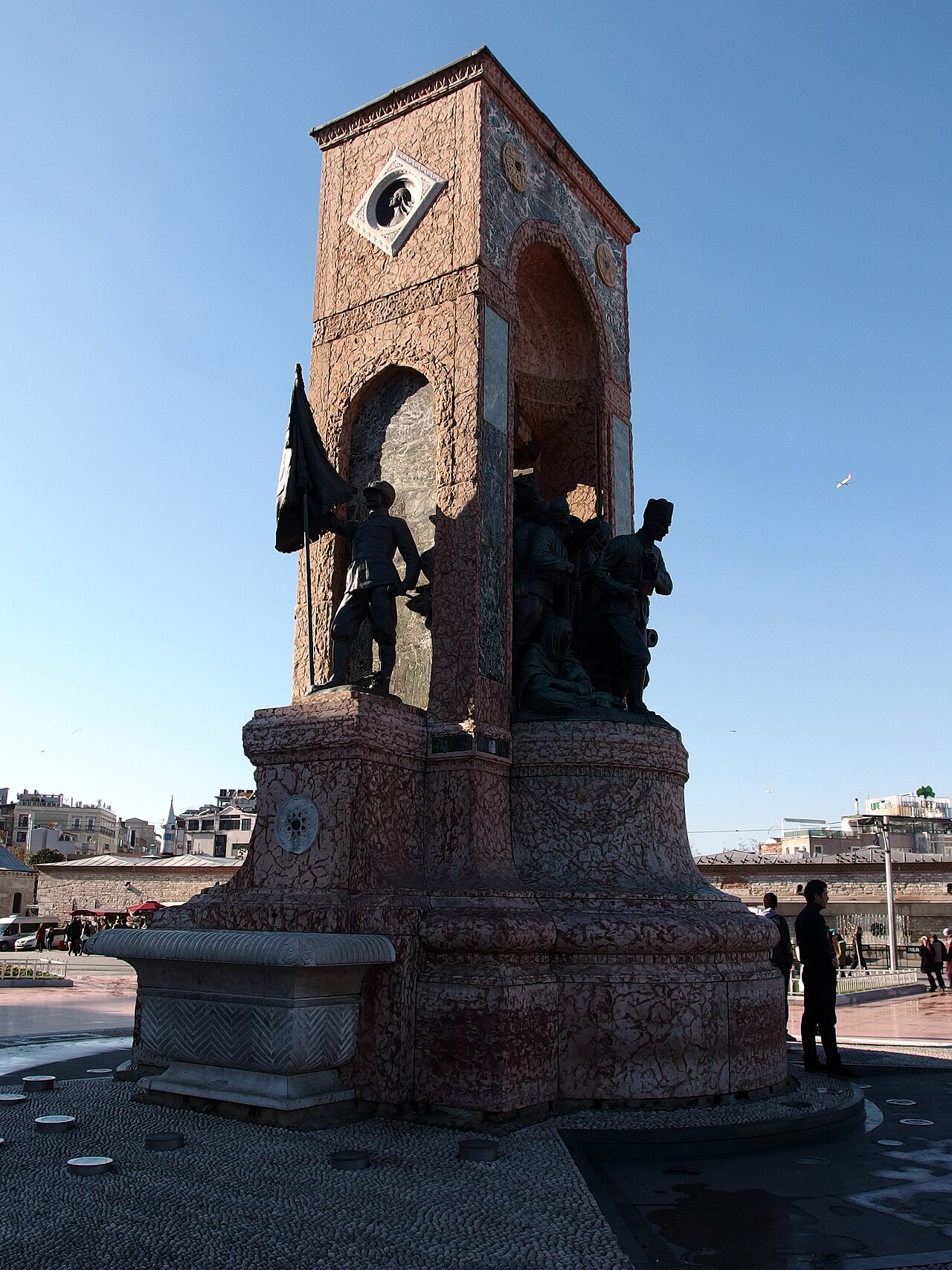
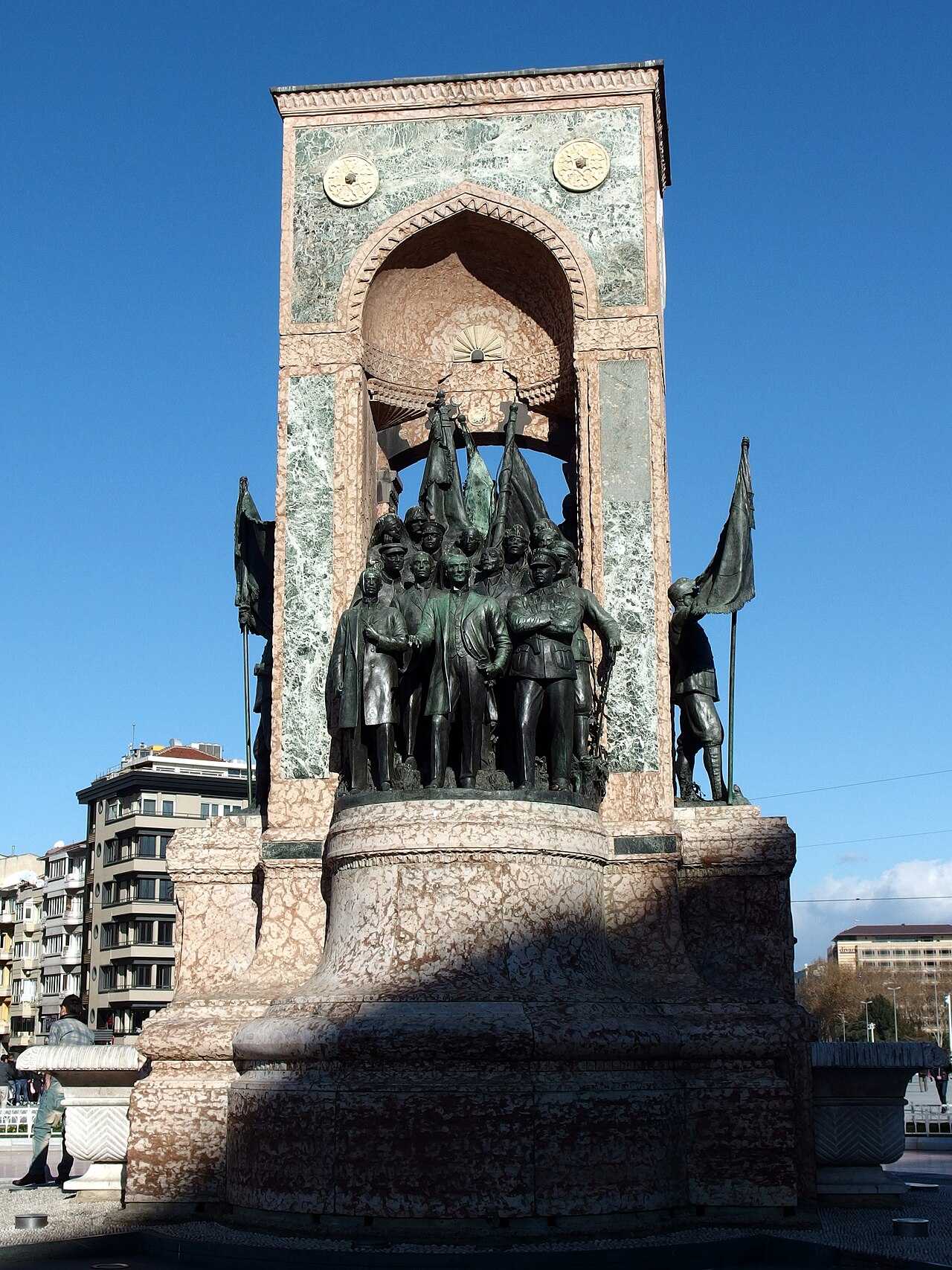
The northern side shows Mustafa Kemal Ataturk in the military dress of the Turkish War of Independence, presenting him as a commander in the field. Walk round to the southern side and the same man appears in modern Western clothing among his companions, presenting him as the statesman of the new republic. The pairing is the argument the monument is making: the soldier of the war and the reformer of the peace are one figure, and the second is what the first was for.
The named figures include Ismet Inonu and Fevzi Cakmak. One of them repays a closer look. Behind Inonu on the southern face stands Semyon Ivanovich Aralov, the Soviet ambassador, included in acknowledgement of the military and financial assistance the Soviet Union gave during the independence struggle. A foreign diplomat carved into a national founding monument is unusual anywhere, and it records a diplomatic relationship that later Turkish history did not much dwell on.
2026-08-24 を確認しました · ソース

見学時間の目安
Ten minutes, and that is a full visit rather than a rushed one. There is nothing to enter, nothing to buy and no interior circuit. The visit consists of walking the two faces of the sculptural group, standing long enough in front of each to pick out the figures, and stepping back far enough to read the whole eleven metres against the sky.
Give roughly four minutes to the northern face, four to the southern, and the remainder to walking between them and finding the distance at which the monument composes. If the Aralov figure is the reason for the stop, add two minutes on the southern side to locate him behind Inonu.
Because the monument sits inside a square that is a transport interchange, an itinerary should treat it as a punctuation mark rather than a destination: something seen on the way between Istiklal Caddesi and the metro, not a stop that a day is arranged around.
2026-08-24 を確認しました

季節と混雑状況
Taksim Square is open ground with no enclosure and no gate, so there are no opening hours to record and none are recorded here. The monument can be seen at any hour, and it is lit after dark.
Light is the only real variable. The two faces look north and south, which means the southern face carries direct sun through the middle of the day while the northern face stays in shade almost permanently. A visitor who wants both faces legible should come in the middle of a bright day and accept that the war group will always be the darker of the two, or come on an overcast day when the two read evenly and the bronze holds detail better than it does under hard noon sun.
Early morning is the one time the square itself is quiet. By mid-morning it is full, and it stays full until late. National holidays bring official ceremonies to the monument, which is when it is at its most meaningful and least accessible.
2026-08-24 を確認しました
チケット
There is no admission charge. The Republic Monument stands in a public square, has no enclosure and no ticket desk, and is free to approach at any hour of any day. Nothing needs to be booked in advance, no queue forms, and no combined museum pass applies or is needed.
That has one practical consequence worth naming. Because there is no controlled entrance, the space immediately around the monument is shared with everything else Taksim Square carries: transport crowds, street vendors, occasional touts and, on ceremonial dates, barriers. A free monument in a busy square is not the same as an unattended one, and access is sometimes restricted for reasons that have nothing to do with tickets. See the hazards section below.
2026-08-24 を確認しました · ソース


行き方
Taksim is one of the best-connected points in Istanbul, and the monument sits in the middle of the square that all of it converges on. The Istanbul Metro's Taksim station is a central hub and puts a visitor at the square's edge. The funicular from Kabatas, opened in 2006, climbs from the Bosphorus shore in a couple of minutes and is the fastest connection from the ferry piers and the tram line below.
On foot, Istiklal Caddesi runs pedestrianised from the square down toward Tunel, with the nostalgic tram running its length; Tunel at the far end is the world's second-oldest underground railway. Walking up Istiklal from Tunel and arriving at the monument from the west is the approach that gives the square its proper scale, because the street is narrow and the opening at the top is sudden.
From the Asian side, ferry to Kabatas or Besiktas and take the funicular or walk up. Buses from across the European side terminate at or pass through the square.
2026-08-24 を確認しました · ソース


気をつけるべきこと
The square is politically live and that is the first thing to know. Since the Gezi Park protests of 2013, demonstrations here have been restricted and police presence increases markedly on sensitive dates. The monument itself may be fenced off around national holidays, when it serves as the venue for official ceremonies. Neither is dangerous for a visitor, but both can mean arriving to find the approach closed, and photographing security operations is not advisable.
The second is ordinary crowd risk. Taksim concentrates pedestrians from a metro, a funicular, a bus terminus and Istanbul's busiest pedestrian street into one open space. Keep bags closed and in front, particularly in the crush at the top of Istiklal.
The third is exposure. The square has almost no shade and no seating near the monument, so in July and August the ten-minute visit is ten minutes in full sun. The fourth is commercial: shoe-shine and photograph offers made here follow a familiar script, and a polite refusal on the first approach saves a longer negotiation.
2026-08-24 を確認しました · ソース


写真
Eleven metres in an open square is an awkward subject, because the instinct is to step back until the whole thing fits and the result is a small object surrounded by traffic. Do the opposite. Move in close, shoot upward from near the base with a wide lens, and let the bronze figures rise against open sky; the low angle recovers the monumentality that the square's width takes away.
The two faces need different treatment. The southern group in Western dress takes direct sun through the middle of the day and can be shot straightforwardly. The northern war group sits in permanent shade, so expose for the bronze and let the sky blow out, or come on a bright overcast day when both faces hold detail.
For a frame that places the monument rather than isolating it, stand on the eastern side so the Ataturk Cultural Center's facade fills the background, which puts the republic's founding monument and its cultural project in one image. After dark the monument is lit while the square is lit differently, and a long exposure from a low wall catches the movement around a stationary subject.
2026-08-24 を確認しました
よくある質問
Who made the Republic Monument and when was it unveiled?
It was designed by the Italian sculptor Pietro Canonica, took two and a half years to build, and was unveiled on 8 August 1928. It was funded with financial support from the population. The structure stands eleven metres high and consists of bronze figures set in a marble structure.
Why are there two different sides to the monument?
Because it depicts two roles. The northern side shows Ataturk in the military dress of the Turkish War of Independence as a wartime commander. The southern side shows him with his companions in modern Western clothing as the statesman of the new republic. The pairing presents the transition from the soldier of the war to the reformer of the peace as a single figure.
Who is the foreign figure on the Republic Monument?
Semyon Ivanovich Aralov, the Soviet ambassador, who stands behind Ismet Inonu on the southern face. He was included in acknowledgement of the military and financial assistance the Soviet Union provided during the Turkish independence struggle. Inonu and Fevzi Cakmak are the other named figures in the group.
Is there an entrance fee or opening time for the Republic Monument?
No to both. It is a sculpture standing in an open public square with no enclosure, no gate and no ticket desk, so it is free and can be seen at any hour. No opening hours are published because none exist. Access is occasionally restricted around national holidays, when official ceremonies are held at the monument.
How long does it take to see the Republic Monument?
About ten minutes, which is a complete visit rather than a hurried one. There is nothing to enter or queue for. Four minutes at each of the two faces and a few more walking between them and stepping back far enough to read the whole eleven metres covers everything the monument offers.
How do you get to Taksim Square?
The Istanbul Metro's Taksim station is a central hub on the square's edge, and the funicular from Kabatas, opened in 2006, climbs from the Bosphorus shore in a couple of minutes. On foot, the pedestrianised Istiklal Caddesi runs up to the square from Tunel, served along its length by the nostalgic tram. Buses from across the European side terminate at or pass through the square.
どこにありますか
インタラクティブマップを読み込んでいます…
インタラクティブマップを読み込めませんでした。
近くの
計画に組み込む
外部リンク
最終更新日:
情報源: OpenStreetMap コントリビューター, Wikidata ·