宗教施設 · Fatih, イスタンブール
Molla Gürani Mosque
Vefa Kilise Camii


- 今日
- 営業時間の記録なし
- 訪問期間
- 20分
- アクセシビリティ
- 未登録
- 価格
- 未登録
- 評価
- 必見
- ランク
- 8,133 の 123 をランク付け
Molla Gürani Mosqueについて
Known in Turkish as Vefa Kilise Camii — the church-mosque of Vefa — and formally as Molla Gürani Mosque, this is a Byzantine church in the Vefa quarter that was converted after the conquest and has kept both names ever since. Its original dedication is not certain; it was possibly to Hagios Theodoros, St Theodore, but the identification has never been fixed.
Masonry analysis puts the main church in the tenth or eleventh century. It is a cross-in-square of nine metres a side, exemplifying the Komnenian style in Constantinople, with a parekklesion added in the first half of the fourteenth century.
The mosque was founded shortly after 1453 by Molla Gürani, the Kurdish scholar who had been tutor to Mehmed II and who went on to become Şeyhülislam and the first Mufti of Istanbul. It is his name that the building carries officially, and the neighbourhood's name that it carries in practice.
2026-08-24 を確認しました · ソース
中には何が入っているのか
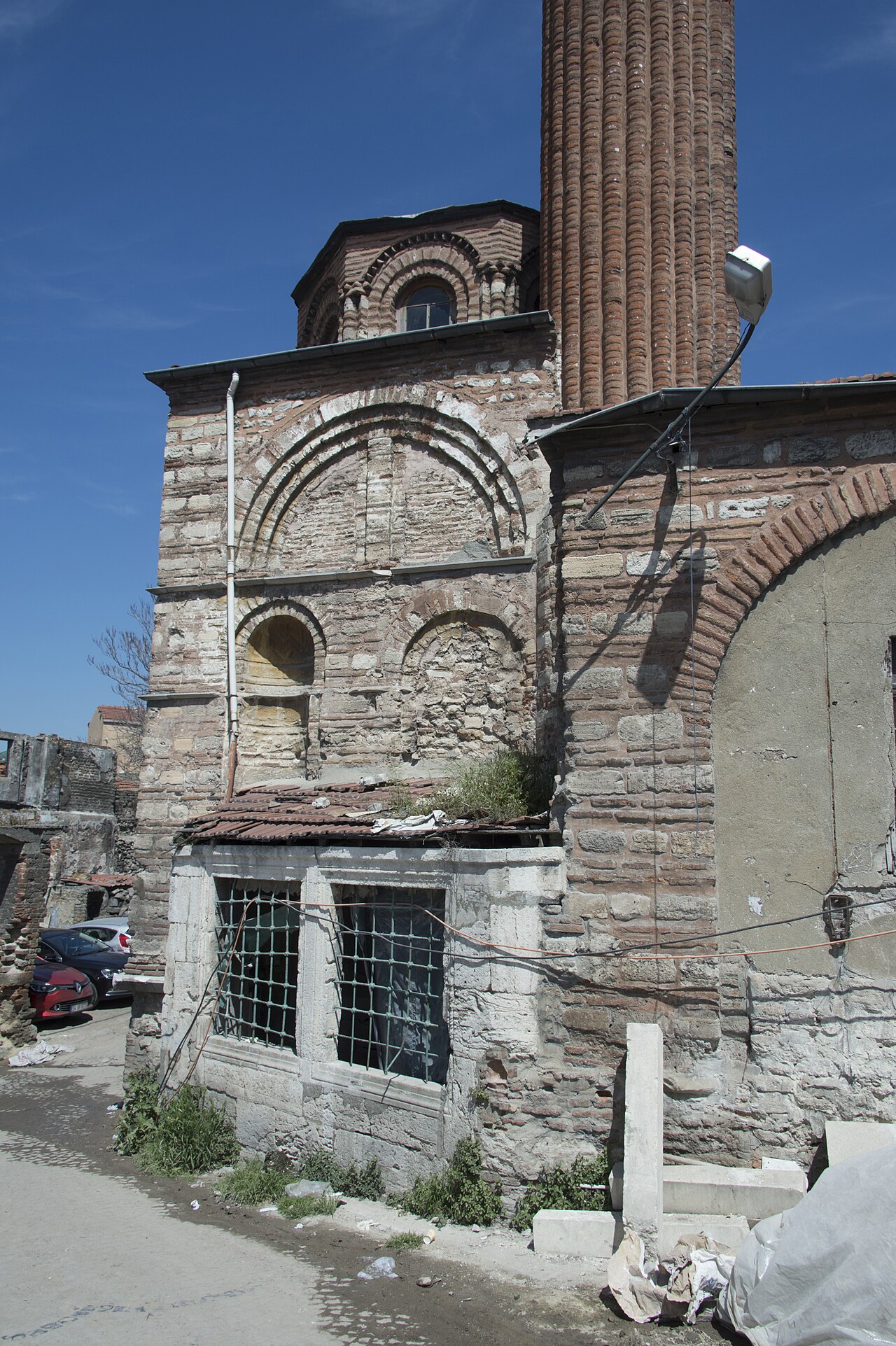
The outer narthex is the reason to come. It is Palaiologan work, later than the church behind it and later than the parekklesia of the Pammakaristos and Chora, and it is built in two orders, both opened with arcades, in banded and colourful brickwork and stonework. Three domes cover it: the two lateral ones of umbrella type, the central one ribbed.
All three domes were once covered with mosaic. The surviving programmes on the south and central domes show the Virgin Theotokos surrounded by prophets, and two imperial officers with prophets. They were cleaned in 1937, had almost completely disappeared by 2007, and a restoration that ran from 2017 to 2021 brought prophet mosaics some seven hundred years old back into view.
Behind the exonarthex the church itself is a modest nine-metre square under its dome, converted for prayer, with a mihrab and a minaret added.
2026-08-24 を確認しました · ソース


見学時間の目安
Twenty minutes covers it: one room, one exonarthex and the exterior. But spend those twenty minutes differently from how most visitors do — the instinct is to walk through the outer narthex into the prayer hall, glance around and leave, when the outer narthex is the building's best thing and needs standing still and looking up.
Give ten minutes to the exonarthex alone, craning at three domes. Five for the facade and its brick banding, five for the interior. Anyone who does the reverse will come away thinking this was a plain small mosque, which is the usual verdict and a mistaken one.
2026-08-24 を確認しました


季節と混雑状況
No visiting hours are published. The building is a working mosque under the Diyanet, and neither the Diyanet's mosque directory nor the Istanbul provincial culture directorate publishes visiting hours for it; the foundations directorate does not either. Nothing is recorded here because the sources carry nothing.
The practical consideration is light rather than time, and it is unusually specific at this building. The exonarthex mosaics are in vaults, in a covered space with arcades open to the outside, so they are read by whatever daylight comes through those arches. That means the middle of the day, on a bright day, is genuinely better here than the golden hour that suits most Istanbul buildings — at dusk the domes go dark and the surviving tesserae simply vanish.
Avoid Friday midday, as at any mosque.
2026-08-24 を確認しました · ソース
チケット
Nothing is published — no fee is stated by any operator, and no operator states that entry is free either. Both were searched for and neither was found, so no charge and no free-entry claim is recorded for this building.
What is true and sayable: this is a functioning mosque rather than a museum, unlike Chora or the Pammakaristos, and mosques in Istanbul are not ticketed. There is no desk, no queue and no pass that applies here. A donation box stands inside as it does everywhere, and contributing is voluntary.
If the building's status were ever changed to a museum the situation would change with it, and any charge would be announced by the ministry rather than by an aggregator or a booking site.
2026-08-24 を確認しました

行き方
The mosque is in Vefa, a few hundred metres west of the Süleymaniye precinct and downhill from it. Walking from Süleymaniye is the obvious approach: leave the mosque's western side and drop through the lanes for five minutes or so. It is a short walk but a steep one in places, with steps.
From the Golden Horn side the climb is longer and harder, and there is no reason to do it uphill when the descent from Süleymaniye exists.
The building is set among ordinary shops and houses on a narrow street and is not signposted for visitors. The exonarthex arcade facing the street is the recognition point — an arcaded, banded brick front unlike anything else on the block. Look for that rather than for a minaret, which is easy to lose among the rooflines.
2026-08-24 を確認しました


気をつけるべきこと
Do not arrive expecting Chora. What survives here is fragmentary and hard-won: an 1848 restoration largely destroyed the mosaics and may have removed the parekklesion altogether, a partial restoration in 1937 uncovered what remained, and by 2007 even that had almost completely disappeared. The 2017 to 2021 campaign brought prophet figures back into view, but this is a building of patches and traces, not of continuous surfaces.
The second thing is physical: the mosaics are overhead, in three domes, and looking at them means standing with your neck back for several minutes in a space that is not lit for viewing. A small torch is not appropriate, but a moment's patience for your eyes to adjust is.
Third, it is a working mosque with a small congregation and no visitor infrastructure. Shoes off, cover up, and if prayer is under way, wait outside.
2026-08-24 を確認しました · ソース


写真
Two subjects, and they want opposite conditions. The exonarthex facade — the two orders of arcades, the banded brick and stone — is an exterior shot that reads best in raking side light, so early or late, standing across the street and far enough back to get both orders in.
The dome mosaics are the harder problem. They are high, shaded and partial, and there is no artificial lighting to help. Bright overcast daylight coming in through the arcade is the best you will get; brace against a pier rather than trying to hand-hold at a slow shutter with your arms above your head.
Do not use flash on the mosaics — it flattens the gold and it is bad manners in a prayer space. Shoot the surviving prophet figures individually rather than attempting the whole dome, which will only record as a dark curve.
2026-08-24 を確認しました
よくある質問
Is Molla Gürani Mosque the same place as Vefa Kilise Camii?
Yes — one building with two names. Vefa Kilise Camii, the church-mosque of Vefa, is what the neighbourhood calls it; Molla Gürani Mosque is the formal name, after its founder. The original Byzantine dedication is uncertain, possibly to Hagios Theodoros, St Theodore, but that identification has never been fixed.
Are the mosaics still visible?
Partly. All three exonarthex domes were once mosaicked; the surviving programmes on the south and central domes show the Virgin Theotokos surrounded by prophets and two imperial officers with prophets. They were cleaned in 1937, had almost completely disappeared by 2007, and a restoration running from 2017 to 2021 brought prophet mosaics some seven hundred years old back into view. Expect fragments and traces, not the continuous surfaces of Chora.
Who was Molla Gürani?
The Kurdish scholar who had been tutor to Sultan Mehmed II, and who later became Şeyhülislam and the first Mufti of Istanbul. He founded the mosque here shortly after 1453, converting the Byzantine church, and the building has carried his name officially ever since even though the neighbourhood name is the one most people use.
How old is the building, and is it all one date?
No — it is layered. Masonry analysis puts the main church, a cross-in-square of nine metres a side in the Komnenian style, in the tenth or eleventh century. A parekklesion was added in the first half of the fourteenth century. The outer narthex is Palaiologan work, later than the parekklesia of the Pammakaristos and Chora, and it is the latest and best part of the fabric.
What are the visiting hours and the entry fee?
Neither is published. Neither the Diyanet's mosque directory nor the Istanbul provincial culture directorate publishes visiting hours for the building, and the foundations directorate does not either; no operator states a fee, and none states that entry is free. It is a working mosque with no ticket desk and nothing to book. Avoid Friday midday, as at any mosque.
When is the light best for seeing the mosaics?
The middle of a bright day, which is the opposite of the usual Istanbul advice. The mosaics sit in three vaulted domes in a covered space lit only by daylight through the exonarthex arcades, with no artificial lighting to help. At dusk the domes go dark and the surviving tesserae simply vanish, so save the golden hour for the brick facade outside.
どこにありますか
インタラクティブマップを読み込んでいます…
インタラクティブマップを読み込めませんでした。
近くの
計画に組み込む
外部リンク
最終更新日:
情報源: OpenStreetMap コントリビューター, Wikidata ·