Monumento storico · Leopoldstadt, Vienna
Synagoge Tempelgasse
Fotografia

Orari di apertura
| Lunedì | 00:00 – 23:59 |
|---|---|
| Martedì | 00:00 – 23:59 |
| Mercoledì | 00:00 – 23:59 |
| Giovedì | 00:00 – 23:59 |
| Venerdì | 00:00 – 23:59 |
| Sabato | 00:00 – 23:59 |
| Domenica | 00:00 – 23:59 |
Analizzato dagli orari di apertura di OpenStreetMap il 2026-08-25.
- Oggi
- Aperto oggi, 00:00 – 23:59
- Durata della visita
- 10 min
- Accessibilità
- Non registrato
- Prezzo
- Non registrato
- Posizione
- Da non perdere · Sito del patrimonio
- Rango
- Classifica 48 di 5,640
Informazioni su Synagoge Tempelgasse
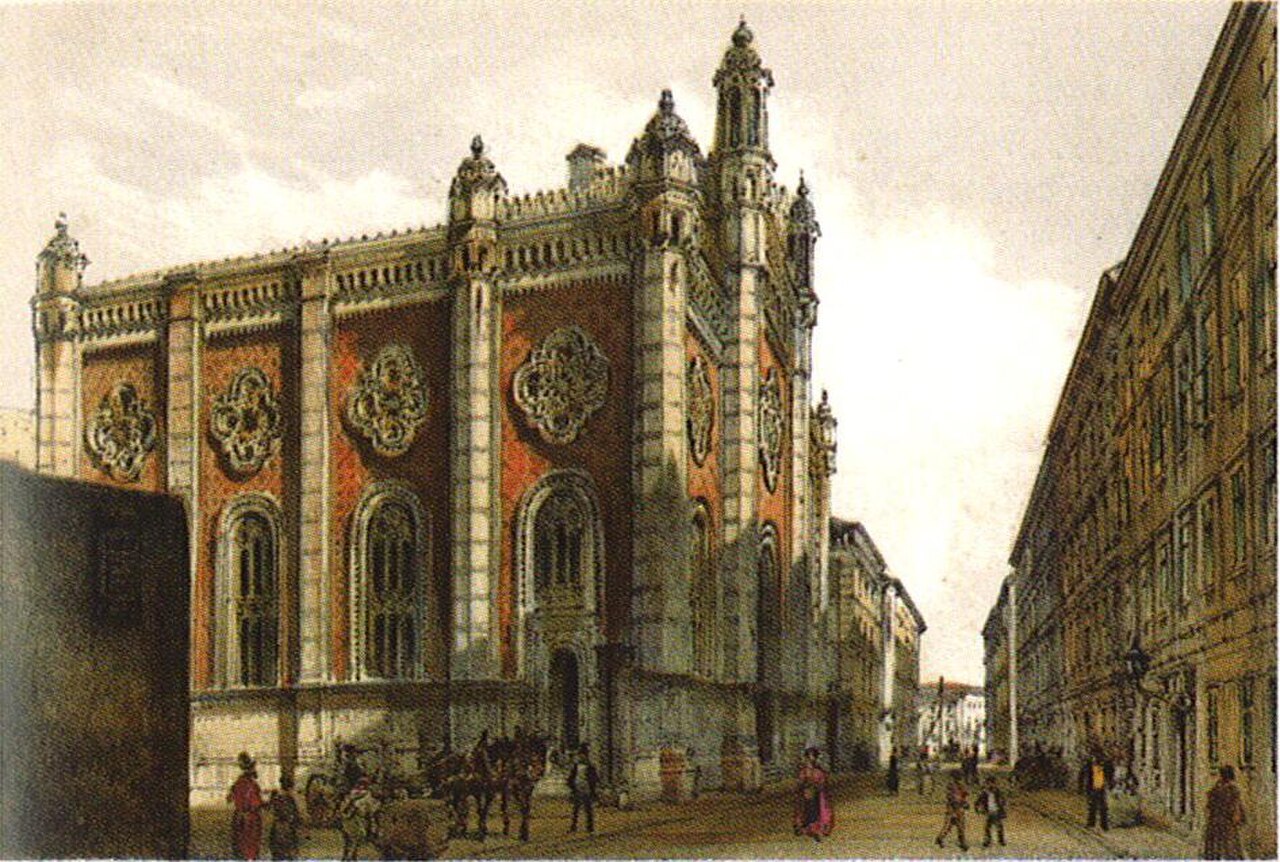
The Leopoldstädter Tempel was a large synagogue on Tempelgasse in Vienna's Leopoldstadt district, designed by Ludwig Förster and completed in 1858 as, after the Stadttempel, one of the city's principal synagogues, seating roughly two thousand worshippers in a Moorish Revival interior. It served the large Jewish community of Leopoldstadt through to the Nazi period.
It was destroyed during the November 1938 pogrom, Kristallnacht, when its interior was burned along with the great majority of Vienna's synagogues and prayer houses. Unlike the Stadttempel, which survived because its position inside a block of buildings made burning it a fire risk to its non-Jewish neighbours, the freestanding Leopoldstädter Tempel had no such protection. The damaged structure stood as a ruin for over a decade and was demolished in 1951.
No synagogue stands on the site today. It is marked as the site of the destroyed Leopoldstädter Tempel rather than presented as a functioning or reconstructed place of worship, and a visit to it is a visit to a memorial site, not to a synagogue.
Controllato 2026-08-24 · Fonte
Cosa c'è dentro
There is no synagogue interior to visit — the building was destroyed in 1938 and its ruin demolished in 1951, and nothing of the original Moorish Revival interior Ludwig Förster designed survives on site. What stands at the address today is a later building on the footprint of the destroyed synagogue, marked with commemorative signage recording what stood there; this guide does not describe the current building's interior use in detail because it was not verified against a primary source at the time of writing, and a visitor should not expect any synagogue space to enter.
Controllato 2026-08-24 · Fonte


Quanto tempo dedicare
Reading the site's memorial signage and standing at the address where the synagogue stood takes five to ten minutes; there is no interior visit to extend it, since no synagogue building remains. Visitors researching Vienna's destroyed synagogues often combine this stop with the still-standing Stadtempel on Seitenstettengasse, a short walk across the Danube Canal, to see both what survived and what did not, which turns a five-minute stop into a half-day walk through the district's Jewish history.
Controllato 2026-08-24 · Fonte
Stagione e folla
The site is a street address in an ordinary residential and commercial part of Leopoldstadt and can be visited at any hour, since it is read from the outside rather than entered. There is no opening-hours question to plan around, and no season changes what can be seen there, since the visit is entirely exterior and entirely about the address rather than a building interior.
Controllato 2026-08-24 · Fonte


Biglietti
There is no admission fee, because there is no attraction to be admitted to — the site is a street address marking a destroyed building, not a ticketed museum or memorial building. No booking, no entry queue and no visitor centre exist at the address, unlike at a purpose-built Holocaust memorial elsewhere in the city.
Controllato 2026-08-24 · Fonte

,_Inneres_der_Synagoge_in_der_Tempelgasse,_(Leopoldst%C3%A4dter_Tempel)_Wien.PNG)
Come arrivare
Tempelgasse sits in Leopoldstadt, the 2nd district, reached from the Taborstraße stop on tram lines running through the district or from the Nestroyplatz station on the U1, both within a short walk. The district sits just across the Danube Canal from the Innere Stadt, and the walk across one of the canal bridges from the old city centre takes roughly fifteen minutes for a visitor who prefers to arrive on foot rather than by tram or metro.
Controllato 2026-08-24 · Fonte
A cosa prestare attenzione
Because no synagogue building survives, a visitor arriving expecting an intact or reconstructed place of worship to enter will be disappointed by the site's history rather than by anything a guide could have prepared better for — the destruction and later demolition are the reason nothing remains. Treat the address as a site of remembrance and read the commemorative signage rather than expecting a conventional sightseeing stop with visitor facilities. There is no shop, no ticket desk and no staffed information point at the address itself.
Controllato 2026-08-24 · Fonte


Fotografia
The site itself offers little to photograph beyond the street address and any commemorative plaque or marker present, since the historic building is gone; a photograph here documents the absence and the memorial signage rather than any architectural subject. Historic photographs of the Moorish Revival synagogue before its 1938 destruction are held in Viennese archive and museum collections rather than at the site itself, and are the more useful record for anyone wanting to see what the building actually looked like before it was burned.
Controllato 2026-08-24 · Fonte
Domande comuni
Can visitors still see the Leopoldstädter Tempel today?
No. It was destroyed during the November 1938 Kristallnacht pogrom, and the damaged ruin was demolished in 1951; no synagogue building stands on the site.
Who designed the Leopoldstädter Tempel?
Ludwig Förster, who completed it in 1858 as one of Vienna's principal synagogues after the Stadttempel.
Why did the Stadttempel survive Kristallnacht but not this one?
The Stadttempel's position enclosed within a block of buildings made setting it alight a fire risk to its non-Jewish neighbours; the freestanding Leopoldstädter Tempel had no such protection and was burned.
How large was the Leopoldstädter Tempel?
It seated roughly two thousand worshippers in a Moorish Revival interior, making it one of the largest synagogues in Vienna at the time it was built.
Is there a memorial at the site today?
The site is marked with commemorative signage recording the destroyed synagogue, though this guide does not describe the current building on the site in detail because it was not verified against a primary source.
Dov'è
Caricamento della mappa interattiva…
Impossibile caricare la mappa interattiva.
Nelle vicinanze
Inseriscilo in un piano
Collegamenti esterni
Ultimo aggiornamento:
Fonte: Contributori di OpenStreetMap, Wikidata ·