Monument historique · Wieden, Vienna
Karlskirche
Photographie
.JPG)
Accès et installations
- Accès sans marche · Non disponible
Lire à partir des balises d'accès OpenStreetMap ; tout ce qui n'est pas répertorié n'a aucune balise enregistrée.
Définissez le type de groupe sur Famille dans le planificateur et les contrats de fenêtre journalière à environ les trois quarts d'une journée en solo.
- Aujourd'hui
- Horaires non renseignés
- Durée de la visite
- 1 heure
- Accessibilité
- Accès avec marches
- Prix
- Non renseigné
- Classement
- Incontournable · Site patrimonial
- Rang
- Rang 11 sur 5,640
À propos de Karlskirche
The Karlskirche was a promise made during a plague. Charles VI vowed to build it in 1713, a year after Vienna's last great epidemic, and dedicated it to Charles Borromeo, who was venerated as a healer of plague victims.
Johann Bernhard Fischer von Erlach won the competition. Building started in 1716 under Anton Erhard Martinelli; Fischer died in 1723 and his son Joseph Emanuel finished the work in 1737.
The dome is 70 m high and the church is 55 m long and 40 m wide.
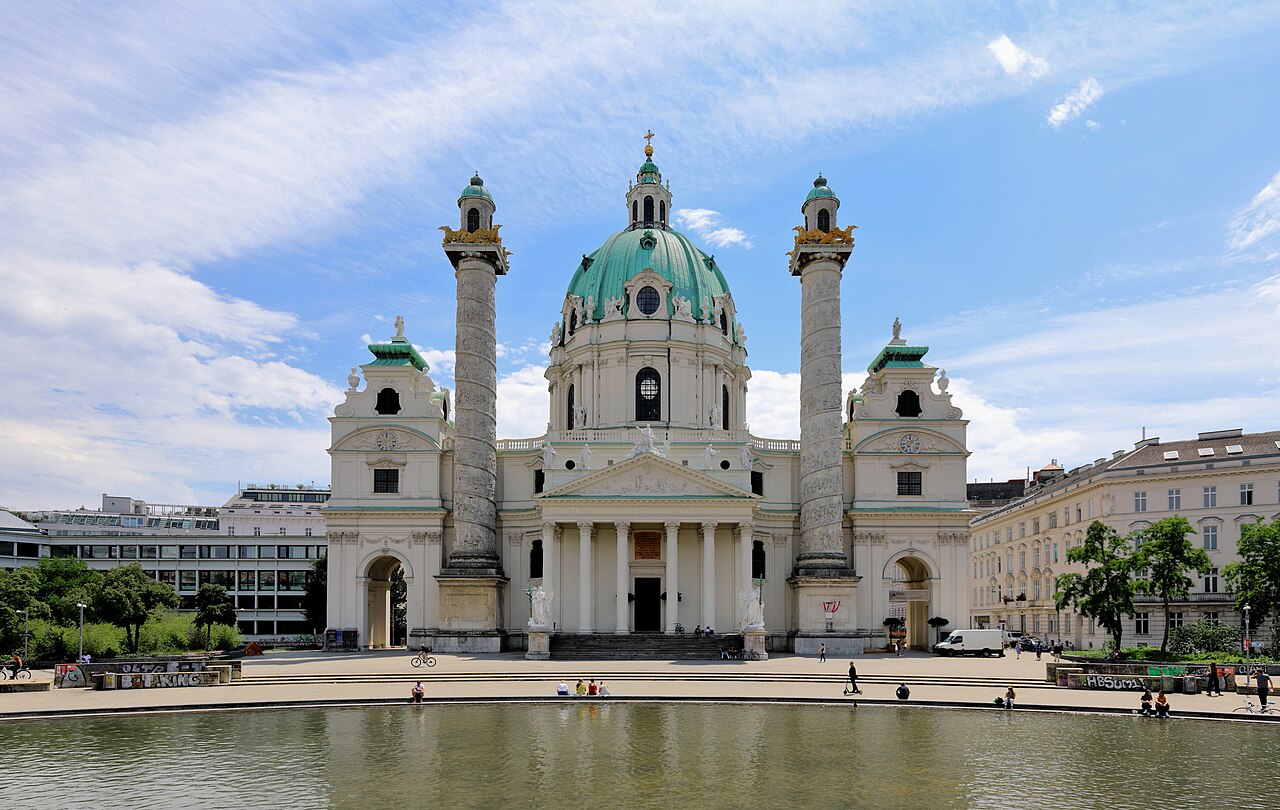
The façade is an argument rather than a style: a Greek temple portico between two Roman columns between two Baroque tower pavilions. Nothing else in Europe looks like it.
Vérifié le 2026-08-23 · Source
Qu'y a-t-il à l'intérieur
A dome fresco you can be lifted into, and two columns copied from Rome.
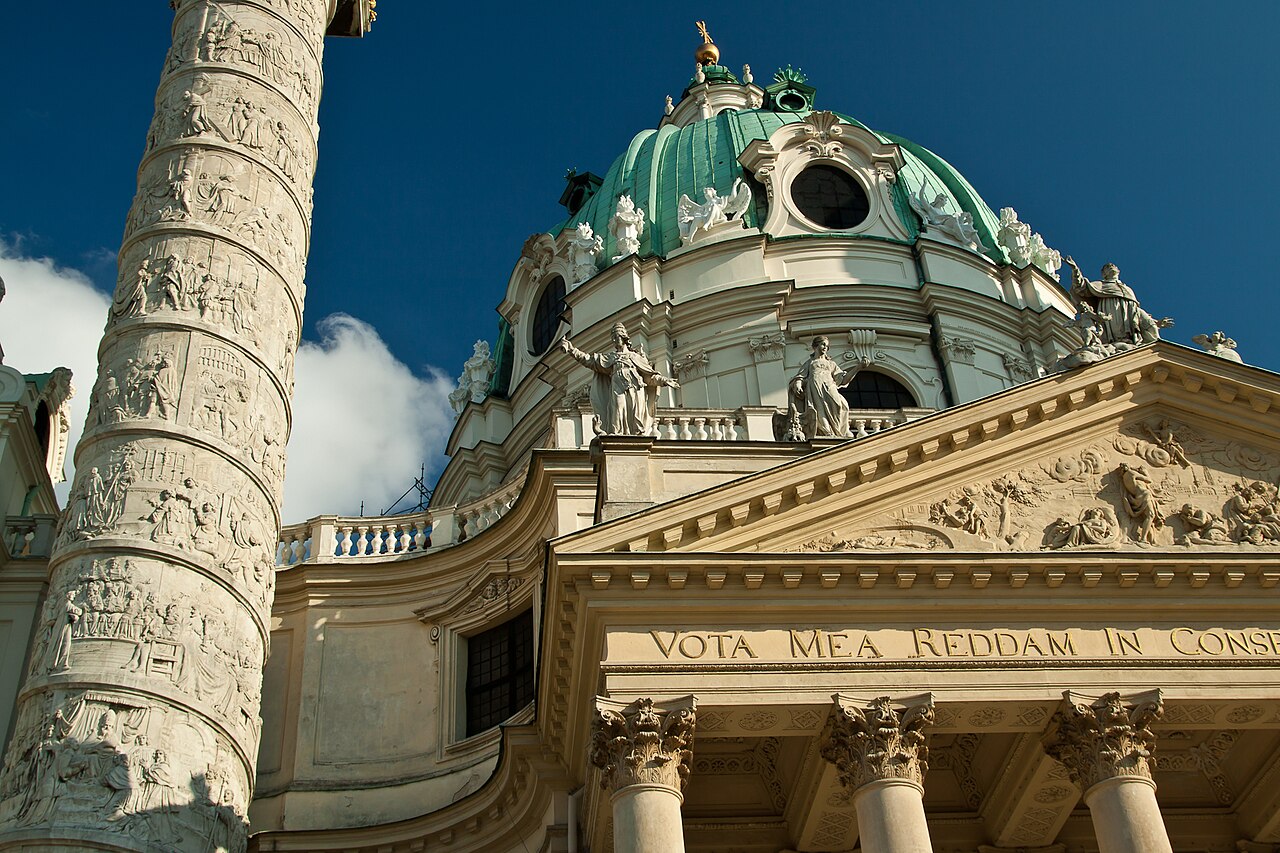
The two columns flanking the portico were carved by Lorenzo Mattielli and are modelled on Trajan's Column, with spiral reliefs telling the life of Charles Borromeo.
Johann Michael Rottmayr and Gaetano Fanti painted the dome fresco — Charles Borromeo interceding with the Virgin. Daniel Gran is credited with chapel frescoes.
A panoramic lift installed inside the church takes visitors up into the dome to within a few metres of the fresco, which is an experience no other Baroque church offers.
Antonio Vivaldi was buried in the adjacent cemetery in 1741.
Vérifié le 2026-08-23 · Source

.jpg)
Combien de temps passer
An hour, and the lift is most of the reason for it.
The nave is read in fifteen minutes. Going up into the dome takes another thirty, including the climb of the last stairs above the lift platform.
The Karlsplatz in front, with its pool reflecting the façade, is worth ten minutes and is where the photograph is taken.
The Wien Museum and the Secession Building are both within ten minutes on foot.
Vérifié le 2026-08-23 · Source

Saison et foule
Late morning, when there is light in the dome.
The fresco is what the lift exists for and it is dim on an overcast day at any hour.
The church is still active — it is cared for by the Knights of the Cross with the Red Star and serves as the parish church for the Catholic student ministry of the Vienna University of Technology — so services take priority over visits.
The lift is not always in place; it has been removed for restoration work in the past.
Vérifié le 2026-08-23 · Source
Billets
The church charges admission, which includes the panoramic lift into the dome when it is operating.
Current rates are not published on the sources this page uses and are not reproduced here.
This is unusual for a Viennese parish church and reflects the lift and the restoration programme rather than the building being a museum.
Concerts are held in the church and are ticketed by their organisers.
Vérifié le 2026-08-23 · Source


Y arriver
The 4th district, Wieden, on the south side of the Karlsplatz just outside the Ring.
Karlsplatz is served by U-Bahn lines U1, U2 and U4 and the Resselpark exit comes up facing the church across the pool. The Ring trams stop at Kärntner Ring, five minutes north.
The U-Bahn has five lines and 109 stations over 83.9 km, running from about 05:00 to 01:00 and all night at weekends.
Vérifié le 2026-08-23 · Source


À quoi faut-il faire attention
The lift into the dome is the reason most people come and it is not permanently installed; it has been removed during restoration work.
The platform at the top is high, open and reached by a final flight of stairs above the lift. Anyone uneasy with heights should know that before buying.
It is a working church with services; the nave belongs to the congregation during them.
Dress and conduct rules apply: shoulders and knees covered, hats off.
The Karlsplatz underground passages and the park have a persistent drug scene, particularly after dark, and are best crossed above ground in the evening.
Vérifié le 2026-08-23 · Source

.jpg)
Photographie
The reflecting pool on the Karlsplatz doubles the façade and is the photograph. Late afternoon lights the front; the water is still in the early morning.
The two columns need to be included or the building makes no sense, which means a wide lens from across the pool rather than a tight one from the steps.
Inside, the dome fresco from the lift platform is as close as anyone will get to a Baroque ceiling, and it is the strongest photograph available in any church in Vienna.
The nave below is dim and needs a support.
Vérifié le 2026-08-23
Questions courantes
Why was the Karlskirche built?
Charles VI vowed it in 1713, a year after Vienna's last great plague epidemic, dedicating it to Charles Borromeo, venerated as a healer of plague victims.
Who designed it?
Johann Bernhard Fischer von Erlach, who won the competition. He died in 1723 and his son Joseph Emanuel completed the church in 1737.
Can you go up into the dome?
Yes, by a panoramic lift installed inside the church, which brings visitors within a few metres of the fresco. It is not permanently installed and has been removed for restoration.
How high is the dome?
70 m. The church is 55 m long and 40 m wide.
What are the two columns?
Copies of the idea of Trajan's Column, carved by Lorenzo Mattielli, with spiral reliefs telling the life of Charles Borromeo.
Is it free?
No. The church charges admission, which includes the dome lift when it is operating — unusual for a Viennese parish church.
Où c'est
Chargement de la carte interactive…
La carte interactive n'a pas pu être chargée.
À proximité
Insérez-le dans un plan
Liens externes
Dernière mise à jour:
Source: Contributeurs OpenStreetMap, Wikidata ·