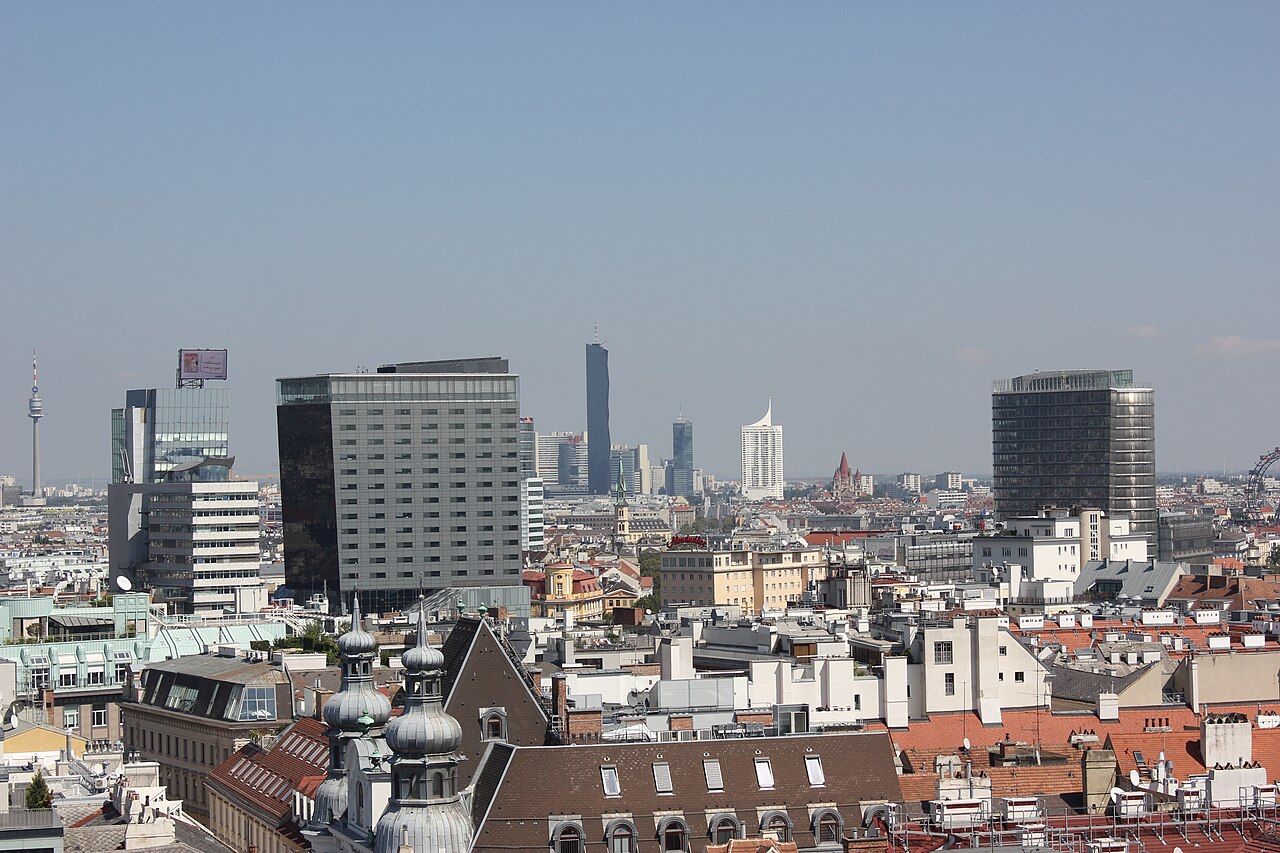
St. Stephen's Cathedral
St Stephen's is the cathedral of Vienna and it stands in the exact centre of the city, which is why every direction in the Innere Stadt is described from it.
- Must see
- Historic monument
- Innere Stadt
Language · 1 published
City guide · Austria
Vienna is 414.78 km² holding 2,028,499 people, and almost everything a visitor comes for sits inside a single ring road less than a kilometre across. The Innere Stadt — the 1st district — is the medieval core, and the Ringstrasse that surrounds it was built in the second half of the nineteenth century on the line of the demolished bastions. The 371-hectare historic centre has been a UNESCO World Heritage Site since 2001; it was on the endangered list from 2017 to 2026. The wider urban area holds 2,223,236 people and the metropolitan area 2,890,577, which makes Vienna the tenth largest city in Europe and by a long way the largest in Austria.
Ranked by importance — sitelinks, pageviews and heritage status, not editor preference.
100 places match
Category
Typical visit duration
St Stephen's is the cathedral of Vienna and it stands in the exact centre of the city, which is why every direction in the Innere Stadt is described from it.
The Vienna State Opera was hated when it opened and it killed both its architects.
The Riesenrad is a Victorian Ferris wheel that has been turning at the gates of the Prater since 1897, and it was built for an emperor's anniversary.
The MuseumsQuartier is one of the largest cultural districts in the world by area, roughly 90,000 square metres, built inside the former imperial court stables, the Hofstallungen, originally constructed in the early eighteenth century under plans associated with Johann Bernhard…
The Rathaus is a Gothic cathedral that turned out to be a town hall, and it is the largest secular building on the Ringstrasse.
The Karlskirche was a promise made during a plague. Charles VI vowed to build it in 1713, a year after Vienna's last great epidemic, and dedicated it to Charles Borromeo, who was venerated as a healer of plague victims.
The Hofburg is not a palace but a district of palaces, and the Austrian president works in it.
The Hundertwasserhaus is a council block, and people fly to Vienna to look at it.
The Musikverein holds the best-sounding concert hall in the world, and it happened partly by accident.
The Naschmarkt is Vienna's largest and oldest continuously running market, a roughly 1.5-kilometre strip of stalls running along the covered-over bed of the Wien River between Karlsplatz and Kettenbrückengasse.
The Austrian Parliament is a Greek temple, and the choice was an argument rather than a fashion.
The Votivkirche exists because somebody tried to kill the emperor and failed.
The Donauturm is the tallest structure in Austria, at 252 m, and it was built as a garden show attraction.
The Burgtheater is Austria's national theatre and one of the most important German-language stages in the world.
The Imperial Crypt is where the Habsburgs are buried, and it is under an ordinary friary church on a shopping street.
The Graben is a broad, elongated square in the Innere Stadt, and its name — 'ditch' — records what it once was: the moat of the Roman legionary camp of Vindobona, filled in during the Middle Ages and built over.
Heldenplatz is an unfinished square in front of the Hofburg, and it is the most politically loaded piece of ground in Austria.
Café Central opened in 1876 inside the Palais Ferstel, a Neo-Renaissance building designed by Heinrich von Ferstel that originally combined the Austro-Hungarian Bank with a covered arcade of shops.
Augarten is a public Baroque park in Leopoldstadt, the 2nd district, laid out in its present form in the early 18th century and opened to the public by Emperor Joseph II in 1775 — one of the earliest palace gardens…
Kohlmarkt is a short pedestrian shopping street in Vienna's Innere Stadt, running from the Graben to Michaelerplatz, where it ends directly at the Michaelertor, the domed gate into the Hofburg.
The Hofburgkapelle, or Court Chapel, stands within the vast Hofburg Palace complex in Vienna. This historic chapel served as the private place of worship for the Habsburg imperial family for centuries.
The Ankeruhr, the Anker Clock, is an Art Nouveau clock built as a bridge between two buildings owned by the Anker Insurance company on Hoher Markt in Vienna's Innere Stadt.
Looshaus is Adolf Loos's 1909-1911 commercial and residential building at Michaelerplatz 3, directly opposite the Michaelertor gate of the Hofburg.
Bermudadreieck is a nightlife district in Vienna's Innere Stadt, centered on the area around Rabensteig, Seitenstettengasse, and Judengasse. The name translates to Bermuda Triangle, referencing how visitors may lose track of time amid its dense concentration of bars and venues.
Äußeres Burgtor, locally known as Burgtor, is a historic gate structure in Vienna. It stands as a significant architectural monument in the city, forming part of Vienna's urban heritage.
The Haas-Haus is a curved glass-and-stone office and retail building on Stock-im-Eisen-Platz, directly opposite the main entrance of St. Stephen's Cathedral, designed by Hans Hollein and completed in 1990.
Altes Palmenhaus is a historic palm house structure in Vienna, Austria. The building represents part of the city's botanical and architectural heritage, situated within the urban landscape of the Austrian capital.
The Leopoldstädter Tempel was a large synagogue on Tempelgasse in Vienna's Leopoldstadt district, designed by Ludwig Förster and completed in 1858 as, after the Stadttempel, one of the city's principal synagogues, seating roughly two thousand worshippers in a Moorish Revival…
The Maria Theresa Monument is a large bronze-and-marble monument to the Habsburg empress, standing at the centre of Maria-Theresien-Platz on Vienna's Ringstrasse, exactly between the Kunsthistorisches Museum (Museum of Art History) and the Naturhistorisches Museum (Museum of Natural History), the…
The Mozart Monument (Mozartdenkmal) is a marble memorial to the composer Wolfgang Amadeus Mozart, standing in the Burggarten, the former private garden of the Hofburg palace in Vienna's Innere Stadt.
The Kuffner Observatory, known locally as Kuffner Sternwarte, is a historic astronomical observatory located in Vienna, Austria. It was established in the late nineteenth century through private patronage and served as an active research institution for several decades.
The Fillgraderstiege is a historic staircase in Vienna, Austria. It connects the districts of Mariahilf and Neubau, specifically linking Fillgradergasse to Theobaldgasse.
The Hotel Imperial is a working five-star hotel on the Ringstrasse, not a museum, so a visitor sees its public rooms rather than a curated interior.
Heiligenkreuzerhof is a historic courtyard complex in Vienna's Inner City, situated near Stephansdom. The site derives its name from Heiligenkreuz Abbey, the Cistercian monastery in Lower Austria that has owned the property for centuries.
Haus Wittgenstein — also called the Stonborough House — is a modernist house at Kundmanngasse 19 in Vienna's 3rd district, built in 1926-1928 for Margaret Stonborough-Wittgenstein, sister of the philosopher Ludwig Wittgenstein.
Palais Harrach is a Baroque palace at Freyung 3 in Vienna's first district, standing beside Palais Kinsky on the same small square, rebuilt into its present form in stages between the late 17th and mid-18th centuries for the Harrach family…
The Palm House (Palmenhaus) is a Victorian-era iron-and-glass glasshouse inside the Schönbrunn palace grounds, built in 1882 by Franz Xaver Segenschmid for Emperor Franz Joseph I.
The Liechtenstein City Palace (Stadtpalais Liechtenstein) is a Baroque town palace at Bankgasse 9 in Vienna's first district, built in stages from the late 17th into the early 18th century as the winter town residence of the princely House of…
Palais Pallavicini is a neoclassical town palace on Josefsplatz in Vienna's Innere Stadt, built in 1783-84 to a design by Ferdinand von Hohenberg for Count Johann Karl Philipp Cobenzl.
Palais Strozzi is a historicist-era palace in Vienna, one of a group of grand town palaces built in the second half of the nineteenth century for the city's aristocratic and mercantile families in the decades after the old fortification ring…
Palais Trautson is a Baroque palace on Museumstraße, built in the 1710s by Johann Bernhard Fischer von Erlach, one of the leading architects of Austrian Baroque and the designer of the Karlskirche, for Johann Leopold Donat Trautson.
The Episcopal Palace, known locally as Erzbischöfliches Palais, serves as the residence of the Archbishop of Vienna. Located in the historic centre of Vienna, this significant ecclesiastical building represents an important institutional presence in the city's religious and architectural heritage.
The Monument against War and Fascism is an open-air group of four bronze and stone sculptures by Alfred Hrdlicka, standing on Albertinaplatz behind the Vienna State Opera and beside the Albertina.
Palais Equitable is a historicist office building on Stock-im-Eisen-Platz, at the corner where Kaerntner Strasse meets Stephansplatz in Vienna's Innere Stadt.
Palais Esterhazy is a Baroque town palace on Wallnerstrasse in Vienna's Innere Stadt, built in stages from the late seventeenth century and given its present facade in a 1720s remodelling by architect Anton Ospel for the Esterhazy family, one of…
Schottenkirche, the Scots Church, is the abbey church of the Schottenstift, a Benedictine monastery on Freyung in Vienna's Innere Stadt founded in 1155 by Duke Henry II Jasomirgott.
The Stock im Eisen is a nail-studded tree-trunk stump embedded in the corner of Palais Equitable at Stock-im-Eisen-Platz, opposite St. Stephen's Cathedral in Vienna's Innere Stadt.
The Flakturm Augarten (Gefechtsturm) is one of six surviving flak towers built in Vienna during the Second World War. Constructed between 1942 and 1945, these massive reinforced concrete structures served as anti-aircraft gun platforms, command centers, and air-raid shelters.
The Donnerbrunnen, also known as the Providentia Fountain, stands as a significant Baroque monument in Vienna's Neuer Markt square.
The Republikdenkmal, known locally as Denkmal der Republik, is a monument in Vienna commemorating the founding of the Austrian Republic. It stands as a significant historical marker reflecting the transition from monarchy to republican governance in 1918.
The Memorial for the Victims of Nazi Military Justice, known locally as Deserteursdenkmal, is a commemorative installation in Vienna.
The Dreifaltigkeitssäule, or Trinity Column, stands at Radetzkystraße 1 in Vienna's Landstraße district. This religious monument represents the Holy Trinity and forms part of the city's extensive heritage of plague columns and devotional structures erected across Central Europe.
Burg am Leopoldsberg is a historic castle structure situated on Leopoldsberg, a prominent hill in Vienna's northern reaches overlooking the Danube. The site occupies a strategically significant position that has drawn human settlement and fortification across centuries.
Friedensbrücke is a bridge spanning the Danube Canal in Vienna, Austria. Its name translates to Peace Bridge, reflecting its commemorative significance. The structure serves as a vital transportation link connecting different districts of the Austrian capital.
Source: OpenStreetMap contributors, Wikidata ·
District boundaries come from OSM administrative relations, so a district page holds exactly the places inside it — plus, for the islands and the coast, the nearest district by proximity.
Twenty-three districts, numbered roughly in the order they were absorbed, arranged around the 1st.
The Innere Stadt is the 1st and holds the cathedral, the Hofburg, the opera and most of what a short visit will see. Districts 2 to 9 and 20 were incorporated in 1850 and lie inside the Gürtel, the outer ring road; they are the inner districts and are where most visitors sleep and eat. Districts 10 to 19 and 21 to 23 came in between 1874 and 1938, mostly in 1892.
Districts 21 and 22 are across the Danube on the left bank — Floridsdorf is the northernmost part of the city and Donaustadt the largest by area. Districts 2 and 20 sit on the island between the Danube and the Donaukanal.
The postal code gives the district: 1XXA, where the middle two digits are the district number. An address at 1070 is in the 7th.
Checked 2026-08-23
The U-Bahn, the trams, and a ticket that covers both.
The U-Bahn has five lines, 109 stations and 83.9 km of track, and it opened on 25 February 1978. It carried 404.8 million passengers in 2023. Trains run from about 05:00 to 01:00 at intervals of two to fifteen minutes, and run all night at fifteen-minute intervals on Friday and Saturday nights and before public holidays.
A sixth line, the U5, is under construction for completion between 2026 and 2032; the network will then be 90 km with 116 stations.
Tickets are integrated with the trams, the buses and the S-Bahn through the VOR system, so one ticket covers the whole journey. Some airport services are outside it.
Inside the Ring, walking beats all of it.
Checked 2026-08-23
Three to four. Two days cover the Innere Stadt and the Ring — the cathedral, the Hofburg, the opera, the museums on the Maria-Theresien-Platz. A third takes Schönbrunn and the Belvedere, and a fourth allows a proper concert or an afternoon in the wine villages.
Twenty-three of them, numbered roughly in the order they joined the city. The 1st is the medieval centre, districts 2–9 and 20 came in 1850 and lie inside the Gürtel, and the rest arrived between 1874 and 1938. The postal code carries the number: 1070 is the 7th district.
The boulevard built in the second half of the nineteenth century on the line of the demolished city bastions, encircling the Innere Stadt. Most of Vienna's great public buildings face onto it.
For anything beyond the Ring, yes. Five lines, 109 stations, 83.9 km, running from about 05:00 to 01:00 and all night at weekends. Inside the Ring, walking is faster.
April to June and September to October. Summer afternoons reach 27–32°C and the palace gardens have little shade; winter hovers around freezing but brings the concert season and the Christmas markets.
414.78 km² with 2,028,499 people in the city proper, 2,223,236 in the urban area and 2,890,577 in the metropolitan area — the tenth largest city in Europe.
Set your days, your pace and the hours you actually want to be out. The planner works around closing days and travel time, and leaves room to eat.