أثر تاريخي · Fatih, إسطنبول
Serpent Column
Yılanlı Sütun
صورة فوتوغرافية

الوصول والمرافق
- الوصول بدون خطوات · متاح
القراءة من علامات الوصول إلى OpenStreetMap؛ أي شيء غير مدرج ليس له علامة مسجلة.
قم بتعيين نوع المجموعة على العائلة في المخطط وتقلص نافذة اليوم إلى حوالي ثلاثة أرباع يوم منفرد.
- اليوم
- ساعات العمل غير مسجلة
- مدة الزيارة
- 10 د
- إمكانية الوصول
- خالية من الخطوات
- السعر
- دخول مجاني
- المكانة
- يجب رؤيته · موقع التراث
- رتبة
- الرتبة 62 من 8,133
نبذة عن Serpent Column
A battle trophy from 479 BC, standing in a hole in a square in Istanbul. The Greeks who beat the Persian army at Plataea melted down captured Persian weapons and cast three bronze serpents twisted into a column, set a golden tripod and cauldron on top, and dedicated the whole thing to Apollo at Delphi.
Around the coils they inscribed the names of thirty-one Greek city-states that fought, ordered more or less by how many men or how much money each had contributed. That list is the oldest surviving document of the alliance, and it is still legible on the bronze.
Constantine the Great had it brought to Constantinople in 324 to stand on the spina of the Hippodrome. It has been in the same spot ever since, which is close to seventeen centuries in one place after a first career of eight hundred years somewhere else.
تم التحقق 2026-08-24 · المصدر
ماذا يوجد بالداخل
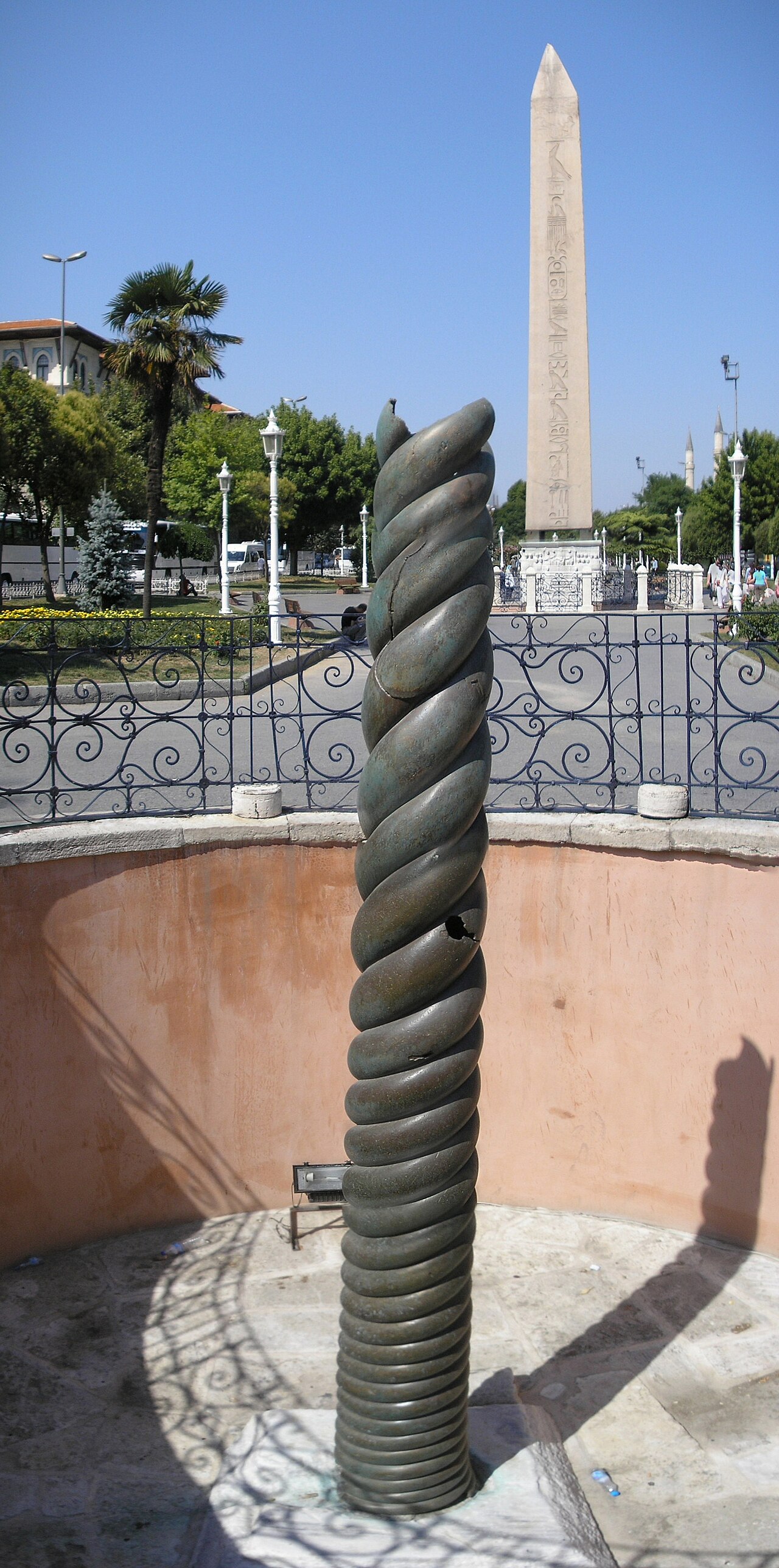
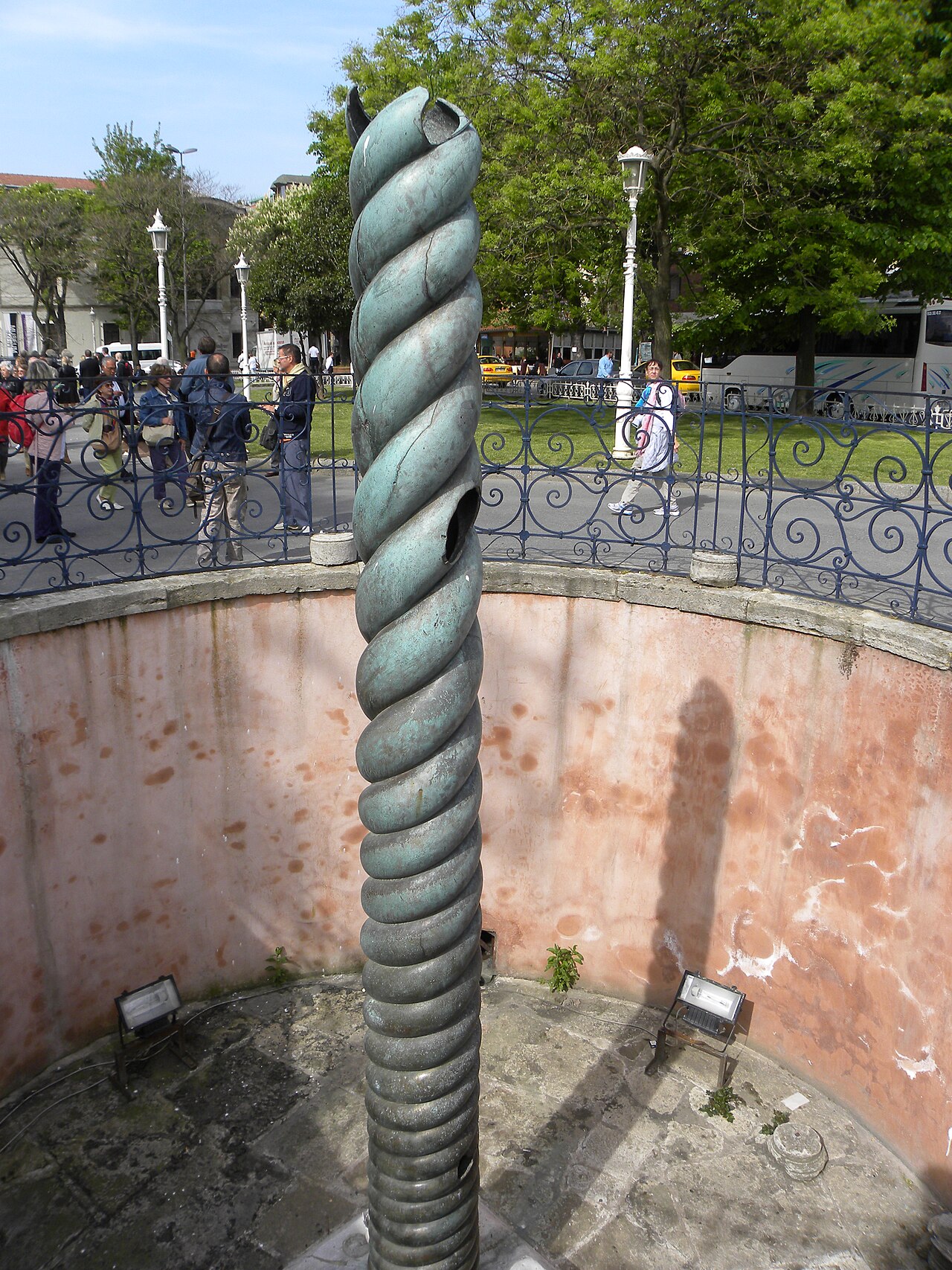
What you see is the bottom of a monument. The column stands about eight metres, three serpent bodies coiled around each other in bronze gone green, with nothing on top: the gold tripod and cauldron are long gone, and so are the heads.
All three serpent heads had been destroyed by the end of the seventeenth century. One jaw is said to have gone within fifty to a hundred years of the Ottoman conquest; the rest came off on 20 October 1700. The upper jaw of one head survives and is displayed in the Istanbul Archaeology Museum, so you can see what is missing by going to look at it a kilometre away.
The inscriptions were buried for centuries when the ground level was raised in 1630 and were brought back to view when the base was excavated in 1855 under Charles Thomas Newton.
تم التحقق 2026-08-24 · المصدر

.jpg)
المدة المقترحة للزيارة
Ten minutes. There is no interior, no circuit and no queue: the column stands in a sunken pit behind a railing in the middle of Sultanahmet Square, and looking at it and reading the plaque is the entire visit.
That is not a criticism of the object, which is one of the oldest things in the city and arguably the most remarkable, but of the encounter. You cannot go down to it, you cannot walk around it at its own level, and the only way to extend the visit is to look harder at the coils for the incised city-state names, which is genuinely worth two or three of your ten minutes.
Treat it as one stop on a walk along the old Hippodrome spina rather than as an outing, and give the walk itself half an hour.
تم التحقق 2026-08-24

الموسم والحشود
No opening hours exist and none is published, which is the honest answer rather than an omission. The column stands in the open, unenclosed square that was the Hippodrome spina, with no gate and no box office, so it is visible at any hour of any day. Nothing about it varies with the season.
Daylight is the only real constraint, and early morning is the clear winner. Sultanahmet Square is one of the most heavily visited spots in Istanbul, and between mid-morning and late afternoon it carries tour groups moving between Hagia Sophia and the Blue Mosque in a more or less continuous stream. At eight in the morning you can stand at the railing alone.
Evening is the other good window, when the square empties and the monuments are lit.
تم التحقق 2026-08-24
التذاكر
Free, and unticketed in the fullest sense. Sultanahmet Square is a public square, entirely open, and the obelisks, the columns and the fountain on the old spina are seen from it without payment, without a gate and without anyone to ask.
This makes the Serpent Column one of the highest ratios of historical significance to cost anywhere in the city: a monument cast in 479 BC that costs nothing to stand in front of at any hour.
The one associated expense is the Istanbul Archaeology Museum, where the surviving upper jaw from one of the serpent heads is displayed. If the column has caught your interest, that museum ticket completes it, and the museum is a short walk away on the far side of Hagia Sophia.
تم التحقق 2026-08-24


الوصول إلى هناك
You do not really go to the Serpent Column; you arrive at it. It stands in Sultanahmet Square in Fatih, on the axis between the Blue Mosque and Hagia Sophia, on the line of the old Hippodrome spina between the Obelisk of Theodosius and the Walled Obelisk.
The tram stop at Sultanahmet puts you two minutes away. Anyone already walking the historic peninsula will pass within fifty metres of it whether they intend to or not, and most people photograph the Egyptian obelisk without registering that the modest green thing further along is a good thousand years older.
Walk the spina in order, from one obelisk past the column to the other. Ten minutes on foot and the three monuments make sense as a set rather than as street furniture.
تم التحقق 2026-08-24


ما يجب الحذر منه
The first thing is the anticlimax. Visitors who know what the column is arrive expecting something imposing and find a headless bronze stump sunk below their feet. The Hippodrome floor lies about two metres beneath the modern square, so the monuments sit in excavated pits and you look down at them rather than up.
The second is the square itself. It is prime working ground for people selling things and running the usual approaches, and a foreign visitor standing still at a railing is the obvious mark. Keep your bag in front of you, decline politely and keep walking.
Do not lean over or reach into the pit. The railing is there for the monument as much as for you.
And do not confuse it with the two obelisks either side, which is the most common mislabelled photograph in Istanbul.
تم التحقق 2026-08-24


التصوير الفوتوغرافي
Everything about photographing this monument is fixed by its being below you. A picture taken standing at the railing looking down produces a green coil against gravel with no sense of what it is. The frame that works puts the column against the sky, which means crouching at the rail and shooting upward so the coils rise out of the pit.
The other useful frame is contextual: the column with the Obelisk of Theodosius or the Blue Mosque behind it, which locates it on the spina and gives a viewer the scale of the square.
For the inscriptions you want a long lens and raking light. The city-state names are shallow incisions in dark bronze and they disappear entirely in flat overhead sun; early or late light across the coils is the only time they read at all.
تم التحقق 2026-08-24
الأسئلة الشائعة
Do I need a ticket to see the Serpent Column?
No. It stands in the open, unenclosed Sultanahmet Square with no gate and no box office, and is free to see at any hour.
What are the opening hours?
There are none published, and the monument very likely has none: it stands in a public square with no enclosure, so it is visible at any time. Only daylight limits how well it can be seen.
How long should I spend there?
About ten minutes. There is nothing to enter and nothing to walk around beyond the railing, so looking at it and reading the plaque is the whole visit.
Where are the serpents' heads?
Destroyed. All three were gone by the end of the seventeenth century, the last falling on 20 October 1700. The upper jaw of one head survives and is displayed in the Istanbul Archaeology Museum.
Why is the column sunk below the square?
Because the Hippodrome floor lies about two metres below the present surface. The surviving spina monuments were excavated in pits within the landscaped square, so visitors look down at them.
What are the inscriptions on the coils?
The names of thirty-one Greek city-states that fought the Persians at Plataea in 479 BC, arranged roughly according to the soldiers or money each contributed. They were re-exposed when the base was excavated in 1855.
أين هو
جاري تحميل الخريطة التفاعلية…
تعذر تحميل الخريطة التفاعلية.
قريب
ضعها في خطة
روابط خارجية
آخر تحديث:
المصدر: مساهمو OpenStreetMap, Wikidata ·